What is new?
New in version 2026.2.0.0 (28th of August, 2026)
- 🚀 NEW: ReplaceMagic.SmartMapper – Intelligent Migration Mapping—the new migration intelligence engine that automatically generates Search/Replace keys, eliminating one of the most time-consuming tasks in large-scale document migrations.
The biggest ReplaceMagic enhancement to date. SmartMapper eliminates the need to manually create thousands of Search/Replace patterns during document migrations. It automatically analyzes the links discovered by a ReplaceMagic scan, applies your migration mapping rules, and generates optimized Search/Replace keys for hyperlinks, SharePoint links, relative links, Excel references, OLE objects, Power Query connections, connection strings, and many other supported link types. Simply review the generated patterns, approve the results, and let ReplaceMagic repair your documents with confidence. See the new SmartMapper Help section for a complete step-by-step guide.
- Improved handling of SharePoint document libraries with mandatory metadata fields. If a required field has no value, ReplaceMagic now reports the actual SharePoint error instead of the previously misleading "Version conflict" message. The new message clearly identifies the problem - "You must fill out all required properties before checking in this document."
- Extended the log file to include the parallelism factor used during processing.
- Added startup event logging (available on request from the ReplaceMagic team for advanced troubleshooting).
- Fixed a problem that could corrupt PowerPoint presentations containing external charts when replacement strings included line breaks. ReplaceMagic now automatically removes line breaks from replacement strings in this specific scenario, ensuring file integrity.Improved processing of HTML (.html and .htm) documents.
- Added protection against generating Excel links that exceed Microsoft's maximum supported length. ReplaceMagic now prevents replacements longer than 253 characters (legacy Excel formats) or 2,000 characters (modern Excel formats), avoiding document repair warnings and hidden or removed link sources.
- Improved processing of Azure Information Protection (AIP) encrypted documents.
- Extended the Azure App Registration documentation with certificate authentication requirements.
- Improved caching of Azure Information Protection authentication.
- Added support for App-only certificate authentication (Microsoft Entra ID) for environments that do not require Microsoft Information Protection (MIP/AIP).
- Fixed replacements in Microsoft Word hyperlinks containing a subaddress (the part following the # character).
Server Migration and Broken Office Document Links: The Complete Fix Guide
A server migration—whether you are renaming a file server, replacing aging hardware, or moving shared drives to new infrastructure—is supposed to be invisible to end users once it is complete. In practice, the migration almost always surfaces one persistent problem that IT teams did not plan for: thousands of Office documents that contain embedded links pointing to the old server name or the old UNC path. Those links are now broken. Documents that previously opened linked data from a network share now display errors. Workbooks that pulled data from other Excel files show broken references. Word documents with linked objects display placeholder boxes instead of live content. This guide covers what happens to embedded Office document links during a server migration, which document types and link types are affected, and how to fix them at scale using ReplaceMagic's server migration workflow.
What Happens to Embedded Links When a Server Is Renamed or Replaced
Every embedded link in an Office document is stored as a string—a path, a URL, or a reference that was accurate when the link was created. When the server that hosts the referenced content is renamed or replaced, that string becomes stale. The document has no mechanism to detect that the server no longer exists at the old name; it simply tries to resolve the reference and fails.
For file server migrations, the typical change is a UNC path substitution: \\OldServer\Finance\Budget2024.xlsx becomes \\NewServer\Finance\Budget2024.xlsx. This looks simple, but the change must be applied to every link in every document across every file share—a task that can encompass hundreds of thousands of files in a large organization.
Which Document Types Are Affected
ReplaceMagic handles link repair across the full range of Microsoft Office document formats:
- Word (.doc, .docx, .docm): Hyperlinks, linked OLE objects, linked images, cross-document references, VBA project references.
- Excel (.xls, .xlsx, .xlsm, .xlsb): External workbook references in formulas, linked charts, OLE objects, named range links, VBA project references.
- PowerPoint (.ppt, .pptx, .pptm): Hyperlinks, linked media, linked OLE objects, action button links, VBA references.
- Visio (.vsd, .vsdx): Hyperlinks, linked data sources, OLE objects.
- Microsoft Project (.mpp): Resource links, cross-project dependencies, hyperlinks.
In environments where multiple Office versions are in use, both the legacy binary formats (.doc, .xls, .ppt) and the modern XML-based formats (.docx, .xlsx, .pptx) are processed correctly.
Which Link Types Break
Hyperlinks
Hyperlinks are the most visible broken link type. Embedded in document text, shapes, or buttons, they point to files, network locations, or web addresses. After a server rename, every hyperlink containing the old server name is broken.
OLE Links and Linked Objects
OLE (Object Linking and Embedding) allows Office documents to embed live references to content in other files—for example, an Excel chart linked into a Word report. The link stores the full path to the source file. When the server is renamed, the OLE link source path is stale and the embedded object cannot refresh its data.
External Link Sources in Excel
Excel workbooks frequently reference cells in other workbooks using formulas like ='\\OldServer\Finance\[Budget2024.xlsx]Sheet1'!$B$4. After migration, every such formula contains a broken path. These broken external references cause recalculation errors and can cascade through dependent calculations.
VBA Project References
Macro-enabled documents sometimes reference external libraries, add-ins, or other documents via VBA code paths. Server renames break these references silently—the code appears intact but fails at runtime when it attempts to access the old path.
Headers, Footers, and Document Properties
Links embedded in document headers and footers, or stored in custom document properties, are frequently overlooked but are repaired by ReplaceMagic as part of a complete fix pass.
Why Opening Each File Manually Is Not an Option at Scale
The instinctive response to a broken link is to open the document and fix it. For a single document this takes a few minutes. For an environment with 20,000 documents across shared drives, the arithmetic is brutal: at five minutes per document, manual repair would require 1,667 hours of focused work—nearly a full year for one person. And that assumes every document can be found, every link type is identified correctly, and no mistakes are made along the way.
The manual approach also misses link types that are not visible in the normal document view. OLE link sources, VBA references, and links in document properties do not appear in the main editing area and require navigating through multiple dialog boxes to find and update. A repair process that relies on human inspection will almost certainly leave a significant fraction of broken links unrepaired.
How to Use ReplaceMagic: The Complete Workflow
Step 1: Run a Pre-Migration Scan
Before the server migration takes place, run ReplaceMagic in scan mode against your file shares. This produces a baseline inventory of every link in every document. The scan identifies the old server name in all its forms—NetBIOS name, FQDN, IP address—so that replacement rules can cover every variant. The baseline also reveals documents that already contain broken links before migration, which is important for scoping the post-migration repair effort accurately.
Step 2: Configure Search and Replace Rules
Using the scan output, configure replacement rules in ReplaceMagic. For a server rename, the primary rule maps the old server name to the new server name across all link types. Additional rules handle variants: the old IP address, alternate path formats, or secondary shares that moved to different locations. Rules are applied to hyperlinks, OLE sources, external formulas, VBA references, headers, footers, and document properties in a single pass.
Step 3: Run a Preview Pass
Before committing any changes, run the replacement in preview mode. ReplaceMagic processes every document and reports exactly what would change in each file—without writing any changes to disk. Review the preview report to confirm that the rules are matching the right content and producing the correct substitutions. Adjust rules if necessary and preview again.
Step 4: Execute the Repair
Once the preview is satisfactory, run the full replacement. ReplaceMagic processes documents in parallel using multiple threads, completing large document sets in a fraction of the time a sequential tool would require. Each processed document is optionally backed up before modification. Metadata—last-modified date, author—can be preserved so that the repair pass does not pollute file system timestamps or SharePoint version histories.
Full instructions for configuring and running the repair are available in the How to Fix Broken Links guide.
Tips for Large Migrations
Batch Processing by Share
For very large environments, process one file share at a time. This makes it easier to validate results, rerun individual batches if rules need adjustment, and distribute work across maintenance windows.
Parallel Licensing for Multiple Teams
ReplaceMagic licenses can be deployed on multiple machines simultaneously, allowing different teams to process different file shares in parallel. For organizations with geographically distributed file servers, this can compress a multi-week repair project into a single weekend. See the ReplaceMagic Professional license options for details.
Preserve Backup Copies
Always configure ReplaceMagic to create backup copies of documents before modification. This provides a recovery path if a replacement rule produces unexpected results in a particular document type or format version.
Key Takeaways
- Server migrations break embedded links in Word, Excel, PowerPoint, Visio, and Project documents by invalidating the server name embedded in every link path.
- Affected link types include hyperlinks, OLE links, external Excel formula references, VBA project references, and links in headers, footers, and document properties.
- Manual repair is not feasible at scale—even 100 documents is a significant manual effort; thousands or tens of thousands requires automation.
- Running a pre-migration scan establishes a baseline and ensures replacement rules cover every variant of the old server name.
- ReplaceMagic processes documents in parallel without requiring Microsoft Office to be installed, completing large repairs quickly and accurately.
Start Fixing Broken Links Today
Download the free trial from the ReplaceMagic Downloads page to scan your document library and see the full scope of broken links before the migration—or after. When you are ready for the full repair, visit the ReplaceMagic Store to select the license that matches your document volume and processing needs.
Why SharePoint Migrations Break Your Office Document Links (And How to Fix Them)
SharePoint migrations are a fact of life in modern enterprise IT. Whether your organization is moving files from a network share to SharePoint, upgrading from SharePoint on-premises to SharePoint Online, or consolidating multiple tenants into one, the migration itself is only half the story. The other half—the part that rarely makes it into the project plan—is what happens to the thousands of Office documents that contain embedded links referencing the locations those files used to live. Links break. Workbooks stop refreshing. Presentations display error placeholders instead of linked objects. Reports point to documents that no longer exist at the expected address. This article explains why each type of SharePoint migration breaks document links differently, and how to fix the problem at enterprise scale.
The Three Main SharePoint Migration Scenarios
Scenario 1: File Server to SharePoint
When an organization migrates content from a traditional Windows file server to SharePoint, UNC paths like \\FileServer01\Departments\Finance\Budget.xlsx are replaced by SharePoint URLs like https://contoso.sharepoint.com/sites/Finance/Budget.xlsx. Every document that embedded a UNC path link to another document now contains a broken reference. The link format changes completely—from a file system path to a web URL—which means simple string substitution is necessary but not sufficient if the file structure was also reorganized during the move.
Scenario 2: SharePoint On-Premises to SharePoint Online
Moving from SharePoint Server on-premises to Microsoft 365 SharePoint Online changes the URL scheme fundamentally. An on-premises link like http://sharepoint.contoso.local/sites/Finance/Documents/Budget.xlsx becomes https://contoso.sharepoint.com/sites/Finance/Documents/Budget.xlsx. The protocol changes (HTTP to HTTPS), the host changes, and sometimes the site structure is reorganized in the process. Documents that contain embedded links to on-premises SharePoint addresses will all fail to resolve after migration. For detailed guidance on this specific scenario, see the SharePoint On-Premises to Online migration guide.
Scenario 3: Tenant-to-Tenant Migration
Tenant-to-tenant migrations are the most complex scenario. In addition to URL changes, the internal SharePoint item IDs that uniquely identify each document within a site are regenerated from scratch in the destination tenant. Documents that were linked using ID-based references cannot be repaired by simple URL substitution; the old ID simply does not exist in the new tenant and must be mapped to the new ID for each target document individually.
Why Each Scenario Breaks Links Differently
In a file server to SharePoint migration, the link format itself changes, but the content being linked has not moved internally—it is just at a new address. Repair is primarily a URL format transformation problem.
In an on-premises to online migration, the domain, protocol, and sometimes the path all change, but the SharePoint internal IDs may be preserved if the migration tool was configured to do so. Repair requires careful URL mapping that accounts for every variant of the on-premises address.
In a tenant-to-tenant migration, all of the above apply, plus ID-based links must be resolved through a mapping table. This makes tenant-to-tenant migrations the scenario most likely to leave persistent broken links if the repair is not planned and executed carefully.
The Scale of the Problem in Enterprise Environments
Enterprise SharePoint environments accumulate content over years or decades. A mid-sized organization with 500 users will typically have tens of thousands of Office documents stored in SharePoint. A large enterprise may have millions. In these environments, even a conservative estimate—say, that 20 percent of documents contain at least one embedded link that breaks during migration—produces a repair scope of thousands to hundreds of thousands of documents.
The problem is compounded because broken links do not all manifest immediately. Users discover broken links organically, weeks or months after migration, when they open a document and find that a linked report no longer refreshes, or that a linked image in a presentation has been replaced by a red X. By that point, the migration project has been closed, the team has moved on, and no one has a complete picture of the repair scope.
What IT Teams Typically Try First (And Why It Falls Short)
The most common initial response is to ask users to fix their own documents. This fails because most users do not know how to locate and update OLE link sources, external formula references, or VBA project paths. They can update a hyperlink they can see, but the deeper link types remain broken.
The second response is to assign the repair to the IT team using manual methods—opening each document, running Find and Replace, and saving. This fails at scale for the reasons described above: it is too slow, too error-prone, and misses link types that are not visible in the editing interface.
Some teams attempt to use PowerShell scripts to search and replace text in document files. This can work for simple hyperlinks in OOXML format documents, but it is fragile, risks corrupting documents if the XML structure is not handled correctly, and does not cover binary format documents, OLE link sources, or Excel external formula references.
How ReplaceMagic's Native SharePoint Integration Works
ReplaceMagic Ultimate connects directly to SharePoint Online using the Microsoft Graph API and SharePoint REST API, allowing it to enumerate document libraries, download documents for processing, and upload corrected versions—all without requiring manual file downloads or uploads. The SharePoint integration guide covers configuration in detail.
When ReplaceMagic processes a document from SharePoint, it downloads the file, applies all configured replacement rules across every link type in the document, and uploads the corrected version back to SharePoint. The entire cycle is automated and runs in parallel across multiple documents simultaneously. A document library containing 10,000 files can typically be fully repaired in a matter of hours rather than weeks.
For the full range of SharePoint migration scenarios, see the Migration to SharePoint overview page.
Metadata Preservation: Why Keeping Last-Modified Date and Author Matters
One concern IT teams frequently raise is the impact of a repair pass on document metadata. If ReplaceMagic updates a document and saves it, SharePoint will record the new save time and the account that performed the save as the last-modified timestamp and last-modified author. This can confuse users who see documents appearing as recently modified when the only change was a URL repair, and it can affect compliance workflows that rely on accurate modification history.
ReplaceMagic addresses this by offering metadata preservation mode. When enabled, the tool reads the original last-modified timestamp and author from the document before processing, then writes those original values back after saving the corrected file. The result is a repaired document whose metadata reflects its original edit history rather than the date of the repair operation.
SharePoint Check-In and Check-Out Handling
Document libraries with required check-out enabled present an additional challenge for bulk processing tools. ReplaceMagic handles check-out automatically: before processing a document, it checks the document out if required by the library settings, processes and uploads the corrected version, then checks the document back in with a configurable check-in comment. Documents that are already checked out by another user are skipped and logged for review, ensuring that the repair pass does not conflict with active user sessions.
When to Involve Expert Support
For organizations with highly complex migration scenarios—multiple source tenants, significant URL restructuring, or a mix of link types that requires a carefully constructed rule set—the ReplaceMagic Consulting Services and Premium Support options provide hands-on assistance from specialists who have worked through dozens of enterprise migration scenarios. Expert involvement at the rule-construction phase significantly reduces the risk of an incomplete or incorrect repair run.
Key Takeaways
- Every major SharePoint migration scenario—file server to SharePoint, on-premises to online, tenant to tenant—breaks embedded Office document links, but each breaks them in a different way.
- ID-based links in tenant-to-tenant migrations require a mapping table and cannot be repaired by URL substitution alone.
- Enterprise environments contain far too many documents for manual repair to be practical; automated bulk processing is required.
- ReplaceMagic integrates natively with SharePoint Online, handling check-out, check-in, and metadata preservation automatically.
- For complex migrations, expert consulting services can dramatically reduce the risk of an incomplete repair.
Ready to Repair Your SharePoint Document Links?
Download the free trial from the ReplaceMagic Downloads page to run your first scan and see exactly which documents are affected and which link types are broken. When you are ready for the full repair, visit the ReplaceMagic Store to find the right license for your environment.
What is new?
New in version 2026.1.0.0 (2nd of January, 2026)
- Fixed an issue where sequential search-and-replace operations on SharePoint pages could overwrite each other. Previously, if one string replacement was executed in one run and a second replacement in a subsequent run, the initial change could be undone. This behavior has now been corrected. More available here!
- Fixed an issue where the size of the Hyperlinks, OLE, Link Sources, Pivot, and PowerQueries result grids was not correctly restored after importing data from previous scanning runs stored in the database.
- Added ReplaceMagic start-up progress bar to visualize what is happening during start of application.
- Added support for Link Source replacements if they are grouped (GroupShape) in PowerPoint documents.
- Added support for OLE replacements if OLE objects are grouped (GroupShape) in PowerPoint documents.
- Added support for nested GroupShares in PowerPoint documents.
- Fixed that when during export there are multiple worksheets all are properly formatted and not only first worksheet.
- Fixed bug as Organization and Anonymous links were not shown in result lists.
- Extended conversion of PDF LaunchActions to URIActions which is required if links are changes from file system to http(s) links. Without this functionality, replacements will work but click on link will not do anything as LaunchActions can open only file links.
- If the replacement link source exceeds 235 characters, ReplaceMagic will not perform the replacement by default. Starting with this version, the notification has been extended to include the length of the replacement as well as the specific replacement value, providing a clearer warning message.
- Extended ReplaceMagic to report how many Excel Cells or PDF Text Fragments, if "update Text" is selected, are processed before timeout. This option is enabled only if you select Replace Preview option:
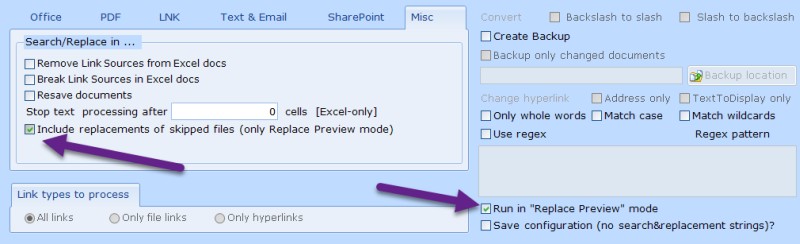

Number of processed cells is shown under "Skipped Documents" tab in Error field:


Same will work also for processing of Text Fragments in PDF documents.
Additionally, ReplaceMagic will also show all potential changes in Search & Replace tab and under Additional Info column, you will see if change belongs to the skipped document:


- Added possibility to stop processing of cells in Excel documents after entered number of cells (if update Text is selected):

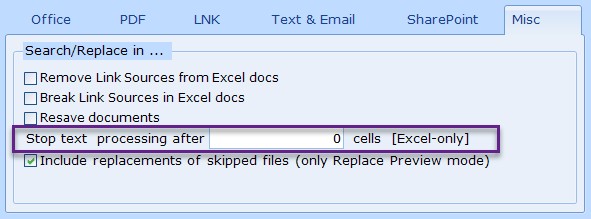
If number is set to 0, no limit is applied. This can be used in combination with "Excel Cells Counter" from Skipped Documents tab but keep in mind that "Excel Cells Counter" is just estimate as it will depend on current run and might happen that during real replacement run this number deviates from what was measured during Replace Preview mode.
Important: processed cells counter is reset after every worksheet!
- Added possibility to import list documents for processing:

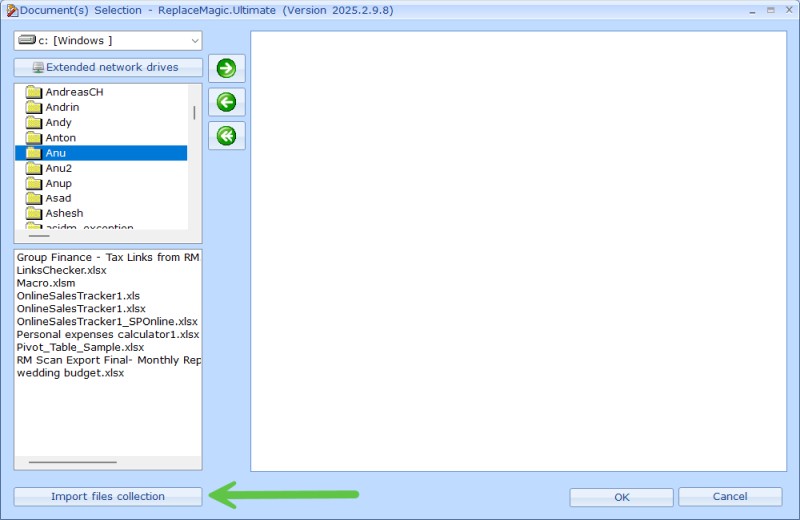
Format is that full document path has to be in single line.
- Fixed bug that import of ultra-fast scanned documents did not work. This will work for future exports!
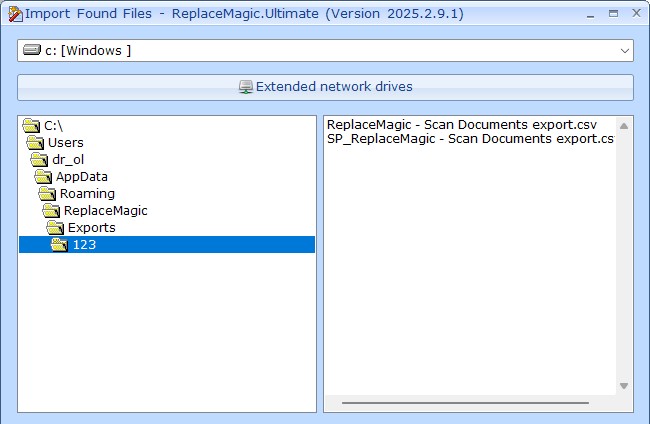
- Added scroll bars (vertical and horizontal) in Import Found Files forms:

- Extended support that export to CSV format is working for more than 1.048.576 lines.
- Per default, in case of changes in text/custom file formats, ReplaceMagic will show as a replacement result search and replace strings as otherwise complete content of text file has to be shown. Now, there is parameter where it can be instructed to show complete text:
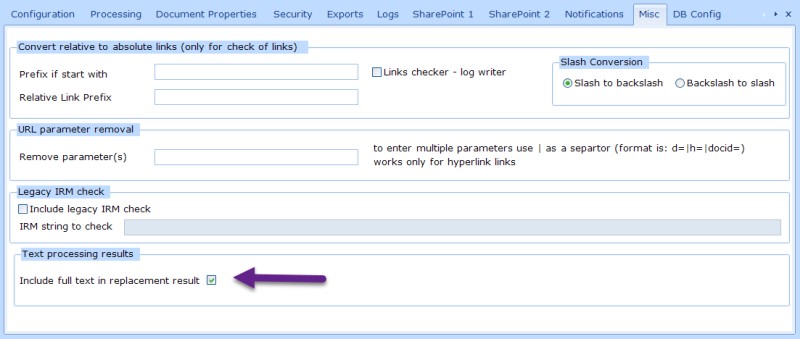
Result will look like:
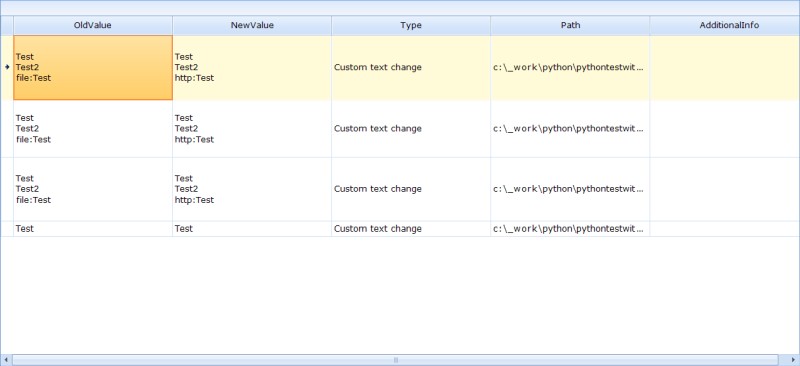
- In case that you want to export replacement run results to Excel but length of OldValue and/or NewValue is longer than 32767 characters export did not work. This is happening as Excel cell has limit to store maximum 32767 characters. To avoid this, replacement run exports where length is above 32767 characters will be limited to this size.
- Export to database rewritten - initially, every new ReplaceMagic could introduce new database structure which would cause that previous saved runs are deleted to be able to recreated new database structure. From this version, we will keep previous runs but, of course, they will miss just included fields tables. Nevertheless, import of older runs should work (runs from version 2025.1 and 2025.2). More details in DB Configuration.
New in version 2025.1 (21st of March, 2025)
- Extended ReplaceMagic with functionality to store scan or replacement results in database (options: SQLite (default, not recommended for larger locations), MySQL or SQL Server (or SQLServer Express)).
Database configuration is possible over Configuration => DB Config:

More details under Configuration => DB Config section
To save scanning results use Export Run in Scan documents tab.
To save replacement results, use Export Run in Search & Replace tab.
To import saved run results use either Import Run in Scan documents or Search&Replace tab or over Configuration => DB Config
- Extended Scan Documents and Search & Replace tab to include filtering and run export and import functionality:


Over Filtering, you can specify which documents should be excluded or included based on provided strings and select where strings should (or not be):

One example - processing of SharePoint locations is always fully on selected location but with filtering you will have option to exclude everything what is not of your interest helping you to reduce number of documents what will be processed.
- Export Run - with this feature you will have possibility to save scanning or replacement in database for later usage:

or

Where you can set run name for later reference and export operation results.
- Import Runs will allow to import previously saved runs and continue processing directly over saved result set:

- Extended document filtering during scanning or replacement process (replacement was added with this release):


More details under:
- Extended ReplaceMagic to allow processing of table content in PowerPoint (process is executed when changes in Text area are selected)
- Further processing performance improvements
- Extended ReplaceMagic to include in scanning result SharePoint shared link and share token. As this will create additional workload on SharePoint, option is not active per default and has to be enabled over Configuration => SharePoint 1:

Already created exports which are used for import will not work any more and it is critical to check if in:
- c:\Users\YOUR_USER\AppData\Roaming\ReplaceMagic"
- "c:\Users\YOUR_USER\AppData\Local\ReplaceMagic"
- "c:\ProgramData\ReplaceMagic"
you have file(s) grid*Layout.xml which has to be deleted as otherwise new exports will not work.
Shared links are used by SharePoint when you click on:

- Limitation: for files with special characters (like # and similar) SharePoint is reporting problems to provide shared link and share token. Following special characters, even if they are allowed in folder/file name, are causing problem to read shared links and/or share token:
- Tilde (~)
- Number sign (#)
- Percent (%)
- Ampersand (&)
- Asterisk (*)
- Braces ({ })
- Backslash (\)
- Colon (:)
- Angle brackets (< >)
- Question mark (?)
- Slash (/)
- Plus sign (+)
- Pipe (|)
- Quotation mark (")
- Limitation: list attachments cannot have shared link/share token and that will be reported in scanning output result
- Limitation: list and/or list item shared links are not supported
- Fix bugs in Pivot processing
- Added functionality to delete result grid layout, if it exists, in case that additional result fields are introduced. Otherwise, exports might not work without manual layout file deletion.
- Export and import functionality completely rewritten. Remark: previous export might not work anymore for import!
- Added option to enable or disable Autofit columns in Excel export. During test run with around 500000 rows for export, with enabled option export took around 80 seconds and without around 20 seconds. This option will shorten duration of large exports:

but columns in Excel file will not be expanded according to the content which can be manually done directly in Excel. Default setting is true (option is enabled).
- Fixed scanning of emails where link is containing %20 which were shown as spaces leading that there was no replacement match.
In today's digital-first world, organizations are increasingly migrating their document storage and management systems to the cloud. Cloud-based solutions offer scalability, cost-effectiveness, enhanced collaboration, and security, making them an attractive choice for businesses of all sizes. However, transitioning from on-premises systems or older cloud platforms to modern cloud-based document management solutions is not without challenges. Among the most pervasive issues encountered during such migrations is the problem of broken links. This article explores the challenges associated with cloud-based document migration, with a particular focus on broken links, and discusses how tools like ReplaceMagic can help resolve these issues efficiently.
The Importance of Cloud-Based Document Migration
Cloud-based document management systems offer several advantages, including:
- Accessibility: Documents stored in the cloud can be accessed from anywhere, facilitating remote work and collaboration.
- Scalability: Organizations can scale their storage requirements based on demand without significant upfront investment.
- Security: Leading cloud providers offer robust security measures, including data encryption and regular backups.
- Cost Efficiency: Cloud platforms reduce the need for maintaining physical infrastructure, cutting operational costs.
Despite these benefits, the migration process often presents significant technical and logistical hurdles.
Challenges in Cloud-Based Document Migration
1. Complexity of Legacy Systems
Many organizations operate on legacy document management systems that were never designed with cloud migration in mind. These systems often lack standard file structures, metadata, and version control, making the migration process complex and time-consuming.
2. Data Volume and Diversity
Large organizations manage vast quantities of data, often in diverse formats such as Word documents, PDFs, spreadsheets, presentations, and multimedia files. Consolidating and transferring this data to the cloud requires careful planning to ensure integrity and usability.
3. Broken Links: A Critical Problem
Broken links are among the most pervasive and disruptive issues encountered during cloud-based document migration. Internal links within documents often point to other files or resources stored in specific locations. When these documents are migrated to a new system, the file paths and URLs may change, causing these links to break.
Why Broken Links Matter:
- Loss of Productivity: Broken links can lead to frustration and wasted time as employees search for missing files.
- Disrupted Processes: Automated workflows dependent on linked documents may fail, disrupting operations.
- Compliance Risks: In industries with strict compliance requirements, broken links can result in non-conformance issues if critical documents are inaccessible.
- User Experience: For organizations offering customer-facing documents, broken links can harm their reputation.
4. Permissions and Security Issues
Migrating documents to the cloud often involves transferring sensitive data. Ensuring that permissions and security settings remain intact during the migration process is critical to preventing unauthorized access.
5. Metadata Loss
Metadata, such as creation dates, authorship, and tags, is often critical for document searchability and organization. During migration, there’s a risk of metadata being lost or corrupted.
6. Downtime and Business Continuity
Migration can disrupt daily operations, especially if unforeseen challenges arise, such as compatibility issues or incomplete transfers.
Addressing Broken Links in Document Migration
Identifying Broken Links
The first step in addressing broken links is identifying their existence and extent. This can be a daunting task when dealing with thousands of files, especially if links are embedded within documents rather than as standalone hyperlinks.
- Automated Scanning Tools: Automated tools can crawl through documents and detect broken links, providing a report for analysis.
- Manual Testing: Although effective for small-scale migrations, manual testing is impractical for larger datasets.
Resolving Broken Links
Once broken links are identified, the next step is to resolve them by updating the link paths to reflect the new file locations. This process involves:
- Mapping Old Paths to New Locations: Creating a mapping between the original file paths and their corresponding locations in the cloud.
- Updating Links in Bulk: Using specialized tools to automate the process of link replacement across multiple documents.
How ReplaceMagic Helps in Resolving Broken Links
ReplaceMagic is a powerful tool designed to simplify the process of updating links and references within documents during cloud migration. Its advanced features make it an invaluable asset for organizations facing the challenge of broken links.
Key Features of ReplaceMagic:
- Batch Link Replacement
ReplaceMagic allows organizations to update internal and external links across thousands of documents in a single operation. This feature is especially useful for large-scale migrations where manual updates would be infeasible.
- Support for Multiple File Types
The tool supports a wide range of file formats, including Microsoft Office documents (Word, Excel, PowerPoint), PDFs, and more. This ensures that all types of files can be processed efficiently.
- Search and Replace Across Directories
ReplaceMagic can search for specific text strings, file paths, or URLs across entire directories and replace them with updated references. This ensures consistency and accuracy.
- Preservation of Document Integrity
Unlike some tools that risk corrupting files during the replacement process, ReplaceMagic ensures that the structure and formatting of documents remain intact.
- Customizable Rules and Filters
Organizations can define custom rules and filters to target specific files or links, making the replacement process more precise.
- Reporting and Auditing
ReplaceMagic generates detailed reports, allowing organizations to track which links were updated and verify the accuracy of changes.
A Step-by-Step Approach to Resolving Broken Links with ReplaceMagic
Step 1: Prepare for Migration
Before starting the migration process, create a detailed inventory of all documents, their locations, and the internal or external links they contain. This inventory will serve as a roadmap for the migration.
Step 2: Install and Configure ReplaceMagic
Download and install ReplaceMagic on a suitable system. Configure the tool by defining the directories to be scanned, the file types to be processed, and the new file paths or URLs.
Step 3: Scan for Broken Links
Use ReplaceMagic to scan the document inventory for broken links. Review the generated report to identify all instances where links need to be updated.
Step 4: Define Replacement Rules
Set up replacement rules in ReplaceMagic to map old file paths to their new cloud-based locations. These rules can be customized to handle different file structures or naming conventions.
Step 5: Execute Batch Replacement
Run the batch replacement operation. ReplaceMagic will update all specified links, ensuring they point to the correct locations in the cloud.
Step 6: Verify and Validate
After the replacement process, use ReplaceMagic's reporting features to validate the changes. Conduct random checks to ensure that all links are functioning correctly.
Step 7: Finalize Migration
Once broken links are resolved and verified, complete the migration process by transferring any remaining data and configuring user access permissions.
Benefits of Using ReplaceMagic for Document Migration
- Time Savings: Automated link replacement significantly reduces the time required to resolve broken links, enabling faster migrations.
- Cost Efficiency: By minimizing manual effort, ReplaceMagic lowers the overall cost of the migration process.
- Accuracy: Automated tools like ReplaceMagic reduce the risk of human error, ensuring links are updated correctly.
- Scalability: ReplaceMagic can handle large volumes of documents, making it suitable for enterprises and organizations with extensive data repositories.
- Seamless User Experience: By ensuring that links remain functional, ReplaceMagic preserves the user experience and minimizes disruption.
Conclusion
Migrating documents to the cloud is a critical step toward modernizing organizational infrastructure and improving operational efficiency. However, challenges such as broken links can hinder the success of such migrations. Tools like ReplaceMagic provide a comprehensive solution to this problem, offering automated link replacement, support for diverse file types, and robust reporting capabilities.
By leveraging ReplaceMagic, organizations can overcome the challenges of broken links and ensure a smooth, efficient, and error-free migration process. This not only saves time and resources but also enables businesses to fully realize the benefits of cloud-based document management systems. For organizations planning a cloud migration, incorporating tools like ReplaceMagic into their strategy is not just an option—it's a necessity for success.
For more information, visit www.replacemagic.com.
To download trial version of ReplaceMagic, go to www.replacemagic.com/downloads.aspx
To see pricing details, go to www.replacemagic.com/store.aspx
Document migration is a critical process in today’s digital workplace. Whether driven by IT upgrades, organizational restructuring, or compliance requirements, moving documents from one network share to another can create significant operational challenges. One such challenge is the proliferation of broken links when documents reference other files or resources that are relocated during migration. In this article, we’ll explore the impact of broken links on productivity and how tools like ReplaceMagic (www.replacemagic.com) can resolve these issues effectively, ensuring a seamless migration process.
The Need for Document Migration
Organizations rely heavily on network shares for storing and sharing critical business documents. However, over time, these shares can become outdated, inefficient, or vulnerable to security risks. Migration to a new network share offers several benefits:
-
Improved Security: Modern network shares often provide enhanced encryption and access control.
-
Cost Optimization: Consolidation of resources reduces storage costs and overhead.
-
Enhanced Performance: Upgraded hardware and infrastructure result in faster file access and better reliability.
-
Compliance: Migration ensures compliance with evolving data protection regulations.
Despite these advantages, document migration can disrupt workflows, especially when linked files are not properly updated to reflect the new structure.
The Challenge of Broken Links
During migration, documents often lose their connection to linked resources. These broken links can take various forms:
-
Hyperlinks in Documents: Links to external files or resources embedded in Word, Excel, PowerPoint, or other document formats.
-
Embedded Images and Media: Media files stored in a different location that the document references.
-
Dynamic Data Links: Excel formulas that pull data from other spreadsheets located in the original network share.
When these links break, it can have widespread consequences:
-
Loss of Productivity: Employees waste time searching for files or recreating links manually.
-
Operational Errors: Broken links can result in incorrect or incomplete data being used in decision-making processes.
-
User Frustration: A significant drop in user satisfaction occurs when previously seamless workflows are disrupted.
-
Compliance Risks: Missing or inaccessible files can lead to non-compliance with data retention policies or legal requirements.
Addressing Broken Links in Document Migration
To mitigate the impact of broken links, organizations need a structured approach:
1. Pre-Migration Analysis
Before initiating the migration, conduct a thorough audit of the existing network share:
-
Identify all documents and their dependencies.
-
Map out the relationships between files and linked resources.
-
Understand the scope and complexity of the migration task.
2. Define Migration Rules
Establish rules to manage file paths, naming conventions, and folder structures in the new network share:
-
Use consistent naming conventions to avoid confusion.
-
Implement a clear directory hierarchy that reflects business processes.
-
Plan redirects for essential links to ensure continuity.
3. Use Automation Tools for Link Fixing
Manual updates to links are impractical for large-scale migrations. Automation tools like ReplaceMagic (www.replacemagic.com) play a vital role in ensuring that links are updated correctly and efficiently.
How ReplaceMagic Can Help with Broken Links
ReplaceMagic is a powerful tool designed to streamline the process of updating links in documents after a migration. It automates the tedious and error-prone task of fixing links, ensuring a smooth transition to the new network share. Here’s how ReplaceMagic can help:
1. Comprehensive File Support
ReplaceMagic supports a wide range of file formats, including Microsoft Office documents (Word, Excel, PowerPoint), PDF files, and more. This ensures that links across different types of documents are updated without manual intervention.
2. Automated Link Updates
ReplaceMagic uses migration rules to identify and replace old file paths with new ones. For example:
-
Replace \\OldShare\Documents with \\NewShare\Documents.
-
Update links in embedded objects and formulas.
-
Ensure that hyperlinks in documents point to the correct location.
3. Bulk Processing
The tool can process hundreds or even thousands of files simultaneously, saving time and reducing the risk of errors. It also provides detailed reports, ensuring transparency throughout the process.
4. Customizable Migration Rules
ReplaceMagic allows organizations to define custom rules based on their specific migration needs. This flexibility ensures that all links are accurately updated, regardless of the complexity of the migration.
5. Preview and Validation
Before making changes, ReplaceMagic provides a preview of the updates. This allows IT teams to validate the changes and avoid unintended modifications.
6. Error Reporting and Troubleshooting
In the rare event of issues, ReplaceMagic provides detailed logs and error reports, making it easy to troubleshoot and resolve problems.
Benefits of Using ReplaceMagic for Document Migration
By leveraging ReplaceMagic, organizations can:
-
Save Time: Automating link updates drastically reduces the time required for migration.
-
Enhance Accuracy: ReplaceMagic eliminates human error in link fixing.
-
Maintain Continuity: Users can seamlessly access and use migrated documents without disruption.
-
Improve Compliance: Ensure that all links comply with regulatory requirements by maintaining accessibility and integrity.
-
Boost Productivity: Employees can focus on core tasks instead of troubleshooting broken links.
Implementing ReplaceMagic: A Step-by-Step Guide
Here’s a simple guide to using ReplaceMagic for document migration:
Step 1: Plan the Migration
Step 2: Install and Configure ReplaceMagic
Step 3: Define Migration Rules
Step 4: Run the Tool
Step 5: Validate Results
Step 6: Finalize and Document
Conclusion
Document migration from one network share to another is a necessary but complex process. Broken links can disrupt operations, reduce productivity, and increase compliance risks. However, tools like ReplaceMagic offer a reliable solution by automating the link-fixing process based on defined migration rules. By planning carefully and leveraging such automation tools, organizations can ensure a smooth and successful migration, maintaining business continuity and enhancing user satisfaction.
For more information, visit www.replacemagic.com.
To download trial version of ReplaceMagic, go to www.replacemagic.com/downloads.aspx
To see pricing details, go to www.replacemagic.com/store.aspx
Migrating documents from SharePoint On-Premises to SharePoint Online is a strategic move for businesses aiming to embrace cloud-based collaboration and scalability. However, one of the most persistent challenges in SharePoint document migration is the occurrence of broken links. When documents are transferred, embedded hyperlinks often lead to outdated paths, disrupting workflows and frustrating users. With tools like ReplaceMagic (www.replacemagic.com/downloads.aspx), organizations can efficiently fix broken links, ensuring a smooth migration process.
Challenges in SharePoint Migration
SharePoint On-Premises to SharePoint Online migration presents several hurdles:
- Broken Hyperlinks After Migration: Many documents contain internal and external links that no longer work after the migration.
- Complexity of Link Updates: Updating embedded links manually is time-intensive and prone to errors, especially in large-scale migrations.
- Throttling Issues: Microsoft enforces API throttling limits, which can delay migrations if not managed properly.
- Tracking Changes: Without proper reporting tools, ensuring that all links have been updated accurately is challenging.
Comprehensive Process for Document Migration and Fixing Links
1. Scanning Documents to Understand Current State
Before initiating a migration, it’s critical to analyze the documents in your SharePoint environment. ReplaceMagic simplifies this process by:
- Scanning documents for broken links: Identifying all files with embedded hyperlinks that might require updates.
- Generating detailed reports: Providing insights into the location and structure of links within the documents.
- Preparing for search-and-replace operations: Helping IT teams categorize and prioritize updates.
This step lays the foundation for efficient SharePoint Online link updates by creating a clear picture of the current state.
2. Preparing Search and Replace Strings
To fix hyperlinks in migrated documents, ReplaceMagic enables you to:
- Define search-and-replace strings: Locate outdated links using search patterns and create replacement strings aligned with new SharePoint Online URLs.
- Simulate link replacements: Test updates to ensure that link formatting and structure are preserved during the process.
Proper preparation is essential for successfully automating link updates in SharePoint Online, saving time and reducing manual errors.
3. Automating Link Updates
The complexity of fixing embedded links in documents is significantly reduced with ReplaceMagic:
- Update links in bulk: ReplaceMagic processes large volumes of documents simultaneously, ensuring efficiency.
- Automating link repair for SharePoint Online: The tool applies predefined search-and-replace strings to update all links in your migrated files accurately.
- Preserving document integrity: The tool ensures that the formatting and content of documents remain intact throughout the process.
4. Strong Reporting and Auditing for Link Updates
ReplaceMagic includes robust reporting capabilities that provide:
- Comprehensive migration tracking: Detailed logs document every link updated, ensuring transparency and accountability.
- Error identification: Highlighting unresolved links or failed updates for follow-up action.
- Auditing capabilities: Strong reporting tools ensure compliance with organizational standards and provide clear documentation of all changes made.
This level of detail simplifies post-migration analysis and gives stakeholders confidence in the success of the SharePoint document migration process.
5. Mitigating Throttling During Migration
Microsoft enforces API throttling limits to ensure system stability. ReplaceMagic addresses these limits by:
- Respecting Microsoft throttling guidelines: Managing API calls within the thresholds recommended by Microsoft.
- Smart protection mechanisms: Automatically pausing, slowdown and accelerate operations when throttling occurs, ensuring uninterrupted updates.
- Recommendation: Optimized scheduling: Allowing link updates during off-peak hours to minimize disruptions.
By mitigating throttling, ReplaceMagic ensures a consistent and efficient migration experience without delays.
Benefits of Using ReplaceMagic for SharePoint Migrations
- Efficiency: Automating link updates saves significant time compared to manual processes.
- Scalability: Handles large-scale migrations with ease, updating links in bulk for SharePoint Online.
- Transparency: Strong reporting tools track every change, providing clear insights and compliance documentation.
- User-Friendly: ReplaceMagic’s intuitive interface makes it easy for IT teams to fix broken links without advanced technical skills.
- Compliance: By adhering to Microsoft’s API throttling policies, ReplaceMagic ensures seamless migration operations.
Conclusion
Migrating from SharePoint On-Premises to SharePoint Online is a necessary step for businesses seeking to modernize their operations. However, addressing broken hyperlinks after migration is essential to maintaining productivity and collaboration. ReplaceMagic provides an efficient and scalable solution, from scanning documents for broken links to automating updates based on search-and-replace strings. Its robust reporting tools and compliance with Microsoft throttling guidelines ensure that migrations are both transparent and effective.
By leveraging ReplaceMagic, organizations can simplify the complexities of fixing embedded links in documents, update links in bulk, and ensure that their SharePoint Online environment is fully operational. Whether it’s tackling broken links or optimizing API usage, ReplaceMagic offers a comprehensive toolset for a smooth and successful SharePoint migration.
Download trial and test it yourself: www.replacemagic.com/downloads.aspx
All prices are visible over: www.replacemagic.com/store.aspx
Migrating documents from network locations to SharePoint is a strategic move for organizations aiming to improve collaboration, streamline workflows, and leverage cloud-based solutions. However, such migrations often come with a common challenge: broken links. As documents are relocated to new SharePoint locations, links embedded in the files referencing their original network locations become invalid. This can disrupt workflows, reduce productivity, and create frustration for end-users.
In this article, we’ll discuss the impact of broken links during migrations, explain how tools like ReplaceMagic (www.replacemagic.com) can address this issue, and provide insights into making the process seamless and efficient.
The Impact of Broken Links in Document Migration
When moving files from network locations to SharePoint, the underlying paths to these files change. Embedded links in Word documents, Excel spreadsheets, PowerPoint presentations, and other file types referencing old locations will no longer work. Common issues caused by broken links include:
- Lost Productivity: Users spend time searching for relocated files.
- Disrupted Workflows: Automated processes or workflows relying on links may fail.
- Inconsistent References: Inaccurate or outdated document references can lead to errors in reports, analysis, and presentations.
To address these challenges, organizations must identify and fix broken links across their document repositories during and after the migration.
ReplaceMagic: A Solution to Link Management During Migration
ReplaceMagic (www.replacemagic.com) is a powerful tool designed to simplify the migration process by identifying and fixing broken links in documents. Here’s how ReplaceMagic can help during the migration from network locations to SharePoint:
1. Automatic Scanning of Selected Locations
ReplaceMagic scans specified folders, network locations, or document libraries to identify all the documents that may contain links. This step is crucial for creating a comprehensive inventory of files requiring updates.
2. Identification of All Links in Documents
The tool examines documents and extracts all embedded links, including hyperlinks, references to external files, and even internal links between sections of a document. This ensures no broken link goes unnoticed.
3. Identification of Broken Links
ReplaceMagic automatically checks if links point to valid locations. If they are broken due to migration, they are flagged for correction.
4. Bulk Updates Using Search and Replace
With ReplaceMagic, organizations can define search and replace strings to fix broken links efficiently. For example:
This bulk replacement feature eliminates the need to manually edit each file, saving time and ensuring accuracy.
Key Benefits of Using ReplaceMagic for Migration
- Time-Saving Automation: By automating the scanning and fixing process, ReplaceMagic drastically reduces the manual effort required during migration.
- Error Reduction: Automated updates reduce human errors, ensuring all links point to the correct SharePoint locations.
- Comprehensive Support: ReplaceMagic supports various file types, including Microsoft Word, Excel, PowerPoint, Visio, and even PDF files.
- Seamless Migration: Fixing links ensures that documents retain their usability post-migration, minimizing disruptions for users.
Steps for a Successful Migration from Network Location to SharePoint
- Plan and Organize: Map out the migration process, identifying the documents to be moved and their target SharePoint locations.
- Use ReplaceMagic for Pre-Migration Scanning: Identify documents with links that need updating.
- Migrate Documents to SharePoint: Transfer files to their new locations in SharePoint.
- Fix Links Using ReplaceMagic: Apply search and replace rules to update links, ensuring they point to the correct SharePoint locations.
- Test and Validate: Verify that all links are functional and documents are accessible from their new SharePoint homes.
Why Migrate to SharePoint?
Migrating from network locations to SharePoint offers numerous benefits:
- Enhanced Collaboration: SharePoint allows multiple users to access and edit documents in real-time.
- Improved Accessibility: With cloud integration, documents are accessible from anywhere, on any device.
- Centralized Management: SharePoint simplifies document organization and version control.
However, these benefits can only be fully realized when common pitfalls like broken links are addressed during the migration process.
Conclusion
Moving from network locations to SharePoint is a smart choice for modern organizations, but it requires careful planning to mitigate the impact of broken links. ReplaceMagic provides a reliable, automated solution to scan, identify, and fix broken links during the migration process. By ensuring that all links are updated accurately, ReplaceMagic helps organizations maintain productivity and avoid disruptions.
If your organization is preparing for a SharePoint migration, consider leveraging tools like ReplaceMagic to make the transition smoother and more efficient.
For more information, visit www.replacemagic.com.
To download trial version of ReplaceMagic, go to www.replacemagic.com/downloads.aspx
To see pricing details, go to www.replacemagic.com/store.aspx